|
| HISTORY
Initially joined to the Asia Minor Coast, Samos became separated from the mainland following enormous geological upheavals. According to the myth it was the birth place of goddess Hera. By being colonized by the Ionians around the first millennium BC, it was inhabited by Carians and Pelasgians. Samos knew its greatest glory in the 6th century BC. |
|
 |
|
| Subsequently it was dominated by the Persians during the Persian Wars, later becoming a member of the Athenian Confederacy. When Samos revolted against the alliance, the Athenians laid waste the island in revenge. It was later conquered by Macedonians, Ptolemies and Romans. |
|
 |
|
In 1204 it became a Frankish possession, remaining in Venetian hands until 1413, when the Genoese under the Giustiniani gained supremacy and ruled the island together with Chios. In 1453 with the fall of Constantinople to the Turks, the island was abandoned, its inhabitants fleeing to Chios. In the 16th century Turkish attempts to resettle Samos succeeded. The island remained under Turkish rule until 1912 when it was finally united with Greece. |
|
| SIGHTSEEING
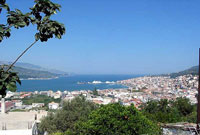
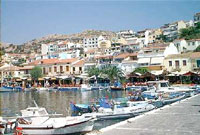
The capital, Samos or Vathy, lies in the eastern part of the island. It is one of its three major ports, the other two being Karlovassi and Pythagorion. There is an Pythagorion Museum; the archeological museum here with local finds, plus a museum of ecclesiastical art, a fine arts museum, Byzantine collection, folk art museum and library. |
|
 |
|
 |
|
Excavations, undertaken primarily by the German School, have unearthed ruins of houses and the ancient acropolis at Pythagorion within a perimeter of approximately 6,400 meters. While the walls enclose an ancient theatre and cemetery, the most important structure is the water Efpalinus Tunnel of Samos, discovered in 1881. Other ruins near Pythagorion include a sanctuary to Hera, whose oldest section has been dated to the 10th century BC. |
|
| In the 7th century the old temple was replaced by a new one designed by the architect Rhoikos. The largest in Greece, it was destroyed by fire in 538 BC. other buildings in the area belong to the Hellenistic and Roman periods. near the village of Kosmadaisi lies the cave of Pythagoras, which tradition maintains was used by the great philosopher-mathematician as a refuge. |
|
 |
|
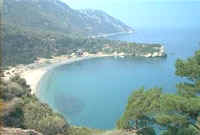
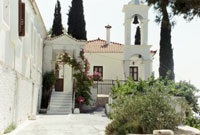
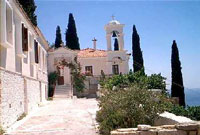
| Another church, the 11th century church of Our Lady; Panagia Potamou, lies near Karlovassi at Potami. Both Agios Haralambos and Our Lady Makrini; Panagia Makrini, on the west coast of the island near Kallithea, have frescoes painted in the 14th century. Samos is ideal for excursions by boat or on foot, swimming and water sports. Kokkari, a charming seaside village with a wonderful beach, is near the capital. The north-east section of the island near the Kotsikas peninsula, is a fun place to explore. |
|
 |
|
 |
|
From here on can get to the islets opposite, Makronisi and Agios Nikolaos. Boats leave from Laka for Kasonisi and from Marathakampos for Samopoula. These uninhabited islands are wonderful for bathing and picnics. The beaches at Karlovassi, Potami and all along the coast from Hereon to Psili Ammos are perfect for swimming and water sports, while hikers and hunters will want to head for the mountains. |
|
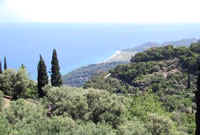
| Samos is blessed with very varied scenery, ranging from rugged mountain peak to verdant valleys and delightful shores. It lush environment combined with its extensive tourist facilities account for the crowds of tourists that flood it every summer. |
|
|
 |
|
|
|