 |
 |
|
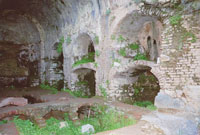
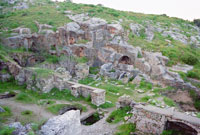
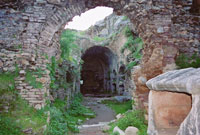
The burial churches built in a natural cave on the skirt of Mount Pion (Panayir), to the north of Ephesus, are known as Seven Sleepers' Grotto. The legend of Seven Sleepers in the Christian tradition is as follows: Probably in the reign of Emperor Decius (250 - 253), seven young Christian men fled from the forced participation in the pagan cults and hid in a cave. |
|
| Having slept for 200 years, they woke up in the reign of Theodosius II (408-450). Their names were Maximian, Malchus, Martinian, Dionysius, John, Serapion and Constantine |
|
| Having woken up from their long sleep, these seven young men lived and died as Christians in a Christian Empire. On the order of the emperor the cave where they had fallen asleep was rearranged with a funerary church with catacombs beneath and around and they were buried there when they died. Later when notables and religious leaders also wanted to be buried here, the area was expanded and the number of tombs was increased. |
|
 |
|
 |
|
The earliest text of the Seven Sleepers of Ephesus is found in the writings of Syrian authors (5th and 6th c. Monophysites). The heroes became Orthodox martyrs and the legend is known in the Latin church since 6th c. It is mentioned as 'The Shrine of Seven Sleepers' in the pilgrimage guide by Theodosius who visited Ephesus in 530 CEo FI. Abradas and Leon, two religious men, built a domed funerary church in the shrine ca. 600. |
|
| In the following years all the available room around was used for burials and even rock was hewn for this. The location of Ephesus on pilgrimage routes to the Holy Land helped the cult of Seven Sleepers spread. Pilgrims from close by or far away lands all visited the Seven Sleepers from the beginning of 12th century on. |
|
| Daniel, a pilgrim, who visited the site about the beginning of 12th c., writes that there were the tombs of many saints here. Perhaps the name of the mount, Panayir" (fair), comes from the pilgrims visiting the site all along the Middle Ages. In the Koran, verses 8-16 of Sura 18 are about the Seven Sleepers who were a topic in Islamic art as well. There are two more sites in Turkey, that are also called Seven Sleepers' Grotto (in Tarsus and Kahramanmaras). |
|
 |
|
 |
|
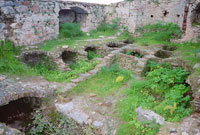
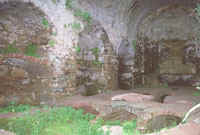
The Grotto of Seven Sleepers was excavated by Austrian Archaeological Institute under the supervision of J. Keil and F. Miltner between 19261928. The noteworthy point about the excavations is that whatever was unearthed conformed with whatever was told by the locals. Funerary churches dated to the 4th and 5th centuries do not have a regular plan. The floors have mosaic pavement under which there are catacombs. |
|
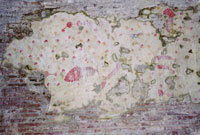
| The superstructure has entirely collapsed but it is understood that in the middle was a dome surrounded by vaults. Frescoes on the walls and vaults have mainly vegetal decoration. There are graffiti done by pilgrims from the West. Most of these are in Greek and Latin, telling about the Seven Sleepers, and some give the names of the pilgrims. The latest dates of graffiti are between 1397 - 1442. |
|
 |
|
| Consequently, tombs and funerary church for the Seven Sleepers were built here first and then gradually other pious people were buried, forming a holy cemetery. In the excavations more than 2000 oil lamps were recovered, that were left as gifts. Most of the oil lamps have cross motifs as decoration. |
| |
|
|
 |
|
|
|
